

Federal Budget 2025: What We Know So Far
As we approach the release of the Fall 2025 Budget on November 4, a clearer picture is emerging of Canada's fiscal landscape. Based on government announcements, leaks, preliminary data, and spending projections, Canada Spends can piece together what the Fall 2025 Budget might look like. Overall, we're seeing reductions in spending on the functions of governments but a large increase in spending on new programs such as Build Canada Homes and defence.
The key question then becomes, will the Fall 2025 Budget help Canada become more productive or simply expand programs without strengthening our economic foundations?
Growth starts with productivity: how much we produce per worker. Without it, wages stall, costs rise, and opportunity shrinks. So, let's dive into what we know about the Fall 2025 Budget thus far and if it's laser focused on Canadian growth.
The Big Picture: A Growing Budget and Deficit
The projected numbers reveal a government facing a fundamental challenge: we’re spending more than ever but not necessarily on things that make Canada stronger.
The real question isn’t just how much we spend, but what we get for it. Does this spending remove barriers that hold businesses back? Does it make it easier to build, hire, and grow? Or does it create new programs that sound good but don’t move the productivity needle for Canada?
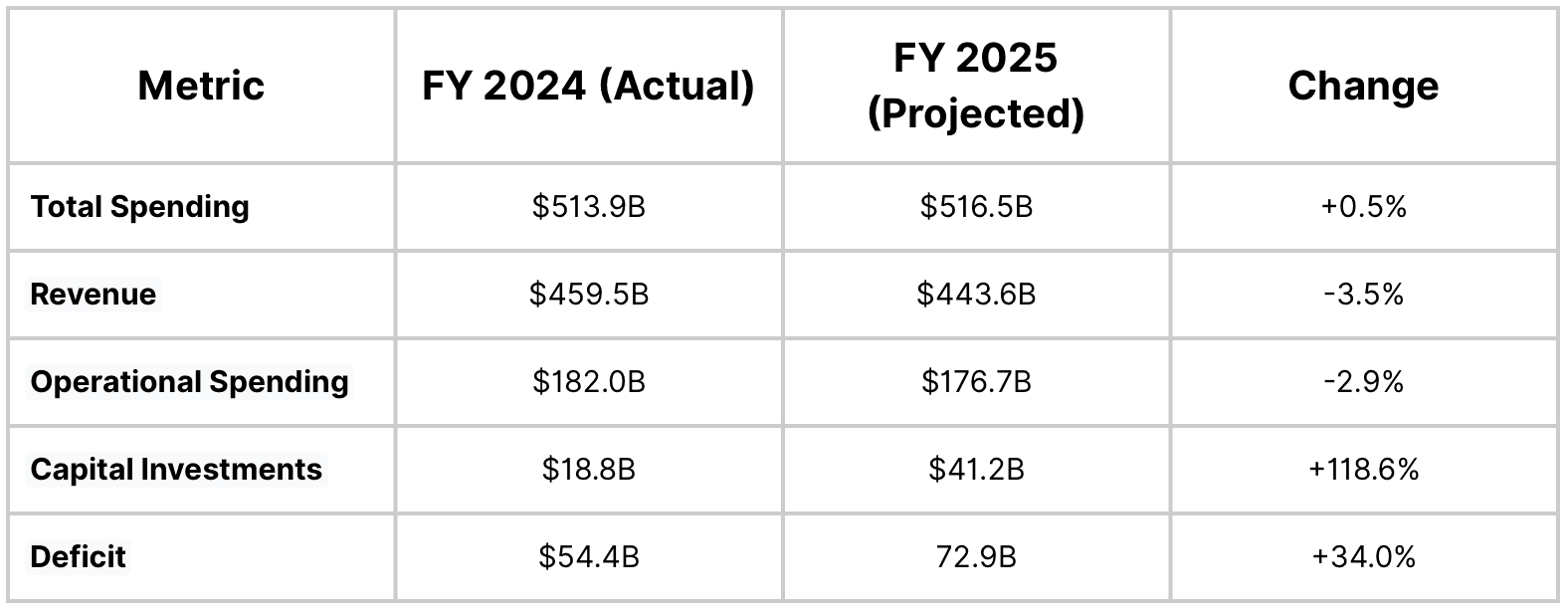 Actual vs Projected Spending Chart
Important note: These figures are based on our best estimates from government announcements, preliminary data, and financial modeling. Official numbers will be released with the Fall 2025 Budget on November 4.
What's Driving These Changes?
The most striking trend is the decline in government revenue (-3.5%) coupled with nearly flat spending growth (+0.5%). This combination has pushed the deficit up by 34% to a projected $72.9 billion, compared to 2024’s $54.41 billion deficit.
Several factors explain the revenue decline in the Fall 2025 Budget:
- Income Tax Cuts (Bill C4): Passed in June 2025, the middle-class tax cut decreases revenue by $5.4B per year.
- Economic Headwinds: Slower growth due to the U.S. trade war is substantially stifling activity and reducing tax revenue.
Meanwhile, operational spending, the amount the government spends on its own operations, is down 2.9%, reflecting the government’s July announcement to cut operational spending by 7.5% in 2026–27. This plan appears to be taking effect ahead of schedule, and the full details of departmental cuts are highly anticipated. Will these figures be close to the 7.5% cut announced by the Minister of Finance in July, or will they come into effect at a slower pace? We will know for sure once the Fall 2025 Budget is out.
Investment vs Operations: A New Framework?
The Carney government has started framing the Fall 2025 Budget around two categories: operational spending (day-to-day government costs) and capital investments (long-term projects like infrastructure and defence).
The messaging from Carney is clear: cut operations, invest in capital.
On paper, this makes sense. However, it raises questions:
- What counts as an “investment”? Real investments drive productivity. They remove red tape, speed up approvals, or make it easier to build in Canada. Spending on programs that don’t improve efficiency isn’t investment; it’s just spending with better branding.
- Are these one-time projects or permanent programs? True capital investments are temporary surges (building a bridge, buying equipment). If “investments” become permanent line items, they’re not capital anymore. They become operational spending in disguise.
- Will this improve productivity or just create more bureaucracy? The test isn’t whether spending is labeled “investment”; it’s whether it makes Canada more competitive, reduces costs for businesses, or speeds up economic activity.
The Fall 2025 Budget will clarify how the government defines these categories. So on November 4th, watch closely. The definitions just by the Carney government matter as much as the dollars.
Major New Investments
Despite overall restraint on government operations, Carney’s government has announced significant new capital investments in key areas, as promised in the Liberal Party's 2025 election platform.
Defence & Security: ~$8.82B Increase
The largest single increase is in defence and security, Carney's main industrial policy:
- $8.7B in additional defence spending announced in August
- $617.7M over five years for the Canada Border Services Agency (≈ $123.5M in the first year)
Together, that's roughly $8.82B in 2025–26, a ~30% increase that moves Canada closer to NATO's 2% of GDP defence spending guideline. We will see if there are further investments in this area as Carney recently pledged to reach NATO's 5% GDP target in the next decade.
The productivity question from Build Canada: Does this spending go toward equipment and capacity that boosts our defence manufacturing base or does it add layers of bureaucracy? Will it create jobs and industrial capacity, or just feed contractors?
Housing & Infrastructure: $13B
Announced in September, the Build Canada Homes program commits $13B to address the housing crisis through:
- New home construction
- Affordable housing initiatives
- Supporting infrastructure for development
- Reducing municipal housing development charges
The productivity question from Build Canada: Housing matters for productivity, a lot. Workers need affordable places to live, and Canadians want to spend less on housing so they can direct more to other parts of life, such as investments or savings. But does the money for Build Canada Homes go toward cutting red tape, speeding up permits, and making it easier to build? Or does it fund new agencies and compliance requirements that slow construction down? As more details emerge about this program, and how the $13B is allocated, we’ll know more.
Economic Stimulus: $6.37B
In response to U.S. tariffs, the government unveiled a "Buy Canadian" industrial strategy with $6.37B in funding to:
- Support domestic manufacturing
- Protect Canadian industries
- Boost competitiveness
The productivity question from Build Canada: Industrial policy can work if it reduces barriers, invests in infrastructure, and helps companies scale. But if it picks winners, subsidizes inefficiency, or creates dependence on government handouts, it’s a drag on growth and competition. We’re watching to see which path this takes in the Fall 2025 Budget.
Social Programs: $216.6M Annually
The National School Food Program will provide $216.6M per year to ensure children have access to nutritious meals.
Where the Money Goes
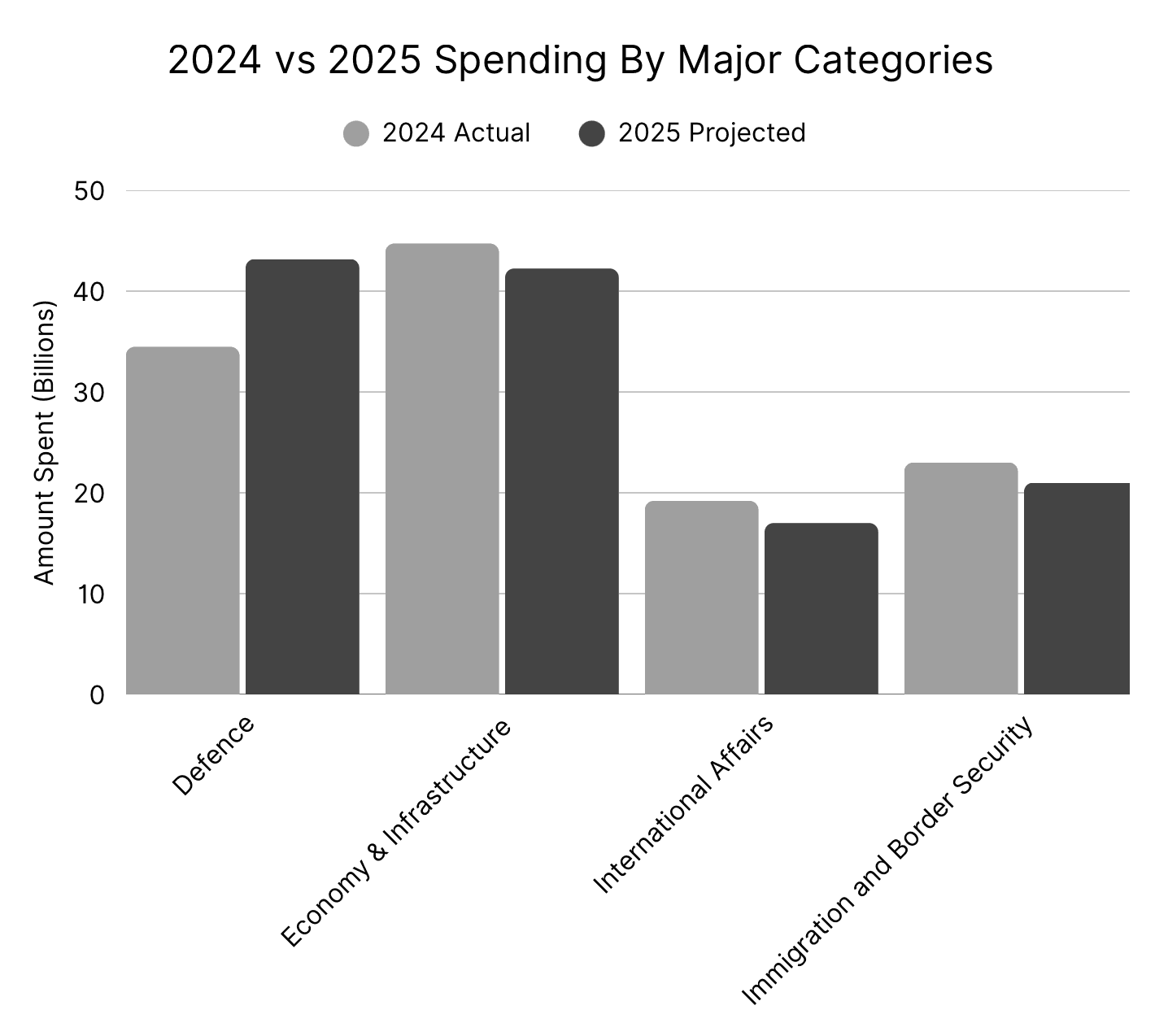 Spending by Major Category
You may be wondering: despite new investments in the Canada Border Services Agency, how can overall spending on Immigration and Border Security go down? If the government cuts the Immigration and Border Security budget by 7.5%, the operational portion declines enough that total spending in the portfolio falls even with targeted CBSA increases.
The Capital Investment Surge
Perhaps the most dramatic change is the 118.6% increase in capital investments, rising from roughly $18.8B to $41.2B. The government's precise definitions of capital and operational spending will be clarified in the Fall 2025 Budget. Regardless, this surge reflects:
- Infrastructure projects (housing, transit)
- Defence equipment purchases
- Long-term economic development initiatives from Bill C5
These investments are unsurprising, as they were heavily touted and promised during the 2025 federal election.
Operational Spending Cuts: The Quiet Story
While new investments grab headlines, the 2.9% reduction in operational spending is equally significant—about $5.3B less in day-to-day government operations.
The July pledge to cut operational spending by 7.5% in 2026–27 suggests this trend will accelerate, potentially saving $11.8B annually once fully implemented.
So far, Carney’s government has said these savings will come from efficiencies and natural attrition in the civil service (retirements and voluntary departures). The Budget will reveal whether that holds true or if transfers to provinces and social programs will face reductions. It will be hard to balance a budget whose deficit has already jumped 34% with civil service cuts alone.
Also, here’s the thing about cutting “operations”: If it means eliminating duplication, streamlining approvals, and making the Canadian government faster and leaner, that’s great. That’s productivity. But if it means cutting frontline services while leaving the bureaucracy untouched, Canadians get worse service for the same tax bill. In inflation-adjusted terms, federal spending has nearly doubled from $7,330 per person in 1974 to $13,536 in 2024, as per Statistics Canada. The question we need to ask ourselves is: are we seeing 2× better service?
We’re also watching how the government defines operational versus capital spending in the Fall 2025 Budget. Our estimates reflect category allocations, but the Ministry of Finance may apply different definitions, an important distinction given Carney’s promise to reduce the operational deficit by 2027–28.
That clarity will also show which departments absorb the largest cuts and how the Carney government will attempt to manage the Fall 2025 Budget’s operational spending while keeping the deficit in check.
The Deficit Dilemma
The projected $72.9B deficit (up from $54.41B in 2024) raises important questions about Canada's fiscal sustainability. At approximately 2.4% of GDP, it is higher than the government’s informal 2% target.
The cost to service Canada’s debt will likely rise from 2024’s $47.27B.
What's Driving the Deficit?
- Revenue Shortfall: Tax cuts and the carbon tax phase-out reduce income.
- Strategic Investments: One-time capital spending on housing and infrastructure.
- Economic Conditions: Slower growth from the U.S. Trade War dampens corporate, personal, and GST/HST receipts.taxes.
The deficit increase is partially offset by the Carbon Tax Rebate phase-out ($9.86B in reduced expenses), which mirrors the revenue loss from ending the carbon tax. Since overall spending still exceeds revenue, the Carbon Tax Rebate phase-out further increases the deficit-to-GDP ratio.
What This Means for Canadians
Winners
- Homebuyers: The $13B housing push should increase supply and decrease housing prices across regions affected by Build Canada Homes.
- Defence Sector: Major spending increases could drive jobs and procurement in defence-related sectors across Canada.
- Families with Children: The National School Food Program expands support.
- Manufacturing: The “Buy Canadian” strategy offers a domestic edge.
Trade-offs
- Future Taxpayers: A higher deficit means greater debt-servicing costs.
- Federal Employees: Operational cuts may reduce services or staffing levels across the Canadian civil service.
- Tax Cuts: Revenue-reducing tax cuts from Bill C4 limit future spending room.
Looking Ahead: The November 4th Budget
When the official Fall 2025 Budget is released on November 4, key questions to watch include:
- Deficit Trajectory: Is there a multi-year plan to return to the 2%-of-GDP target?
- Revenue Measures: Will new taxes or other revenue sources address the budget shortfall?
- Program Cuts: Which departments face the deepest reductions? And how quickly will they be affected?
- Economic Growth Assumptions: How optimistic is the government about the recovery?
- Fiscal Anchor: Will the Carney government commit to a clear fiscal rule (e.g., operational balance by 2027–28 or a 2%-of-GDP deficit target), or will the goalposts keep moving?
- Transfers to Provinces: Will health and social transfers remain stable, or will provinces be asked to absorb some of the operational cuts?
- Productivity Measures: Beyond spending, what is the Canadian government doing to reduce red tape, speed up approvals, and make it easier to build and grow in Canada?
The Bottom Line
Based on current data, the FY 2025 budget reflects a government that is:
- Spending significantly in defence, housing, and competitiveness, consistent with the Liberal Party's 2025 election platform.
- Cutting operational costs to reduce the amount spent on government itself and free up resources for capital investments across Canada.
- Accepting a larger deficit in the short term to fund capital projects, such as Build Canada Homes.
- Facing revenue pressures from tax cuts and economic headwinds due to the U.S. Trade War and economic inefficiencies.
But here’s what matters more than the dollar figures: Will this Fall 2025 Budget make Canada more productive?
Real growth comes from removing barriers, cutting red tape, speeding up approvals, and making it easier to build and hire in Canada. Investments only work if they strengthen our economic foundations as a country, not just create new programs.
The core question heading into the Fall 2025 Budget is whether these investments will generate productivity gains that justify the larger deficit, or whether we’re spending more without getting stronger.
We won’t know for months or even years whether these investments will deliver enough growth. What we’ll know on November 4 is whether we are credibly on a path to growth in Canada.
Stay Updated: For the most current data, explore our Fall 2025 Budget Visualizations and follow @canada_spends on social media to be notified on November 4th when the Fall 2025 Budget drops. We will provide rapid visualizations based on the government's released numbers.
Have questions or insights about Canada Spends? Contact us or explore more articles on Canadian fiscal policy.
